Exercise 5.3 - UR effort control using Robotic System Toolbox
In this exercise you will control a Universal Robots manipulator using Simulink.
Start the Simulation
urmodel = 'ur3e'
StartTutorialApplication('Simulation','Controller', 'Effort', 'Model',urmodel, 'Docker', false);
StartTutorialApplication('Trajectory', 'Docker', false);
StartTutorialApplication('Safety_nodes','docker',false, 'model','threelink'); %sends a 0 torque when no other command has been sent
Remember that you can slow down the simulation as:
SetSimulationSpeed( SpeedFactor, 'docker', false)
Load the Robot
import your Universal robot of choice using urdf files and set gravity in -z direction.
Parameters
Setup your parameters as in Exercise 4.2.
Set:
- Kp (can be scale during simulation)
- Kd (can be scale during simulation)
- taulim according to your robot
Configurations
Try different configurations
store them as:
- q_desired_1
- q_desired_2
- q_desired_3
- qd_desired
Visualization
compute the transform of the desired configurations and visualize it in rviz.
Dashboard
In the Simulink file you will find the dashboard section that allows you to switch between the configurations, see the current torque output and scale the Kp and Kd matrix during simulation.
Configuration Selector
Check one of these boxes to select the desired configuration.
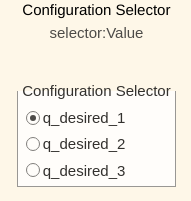
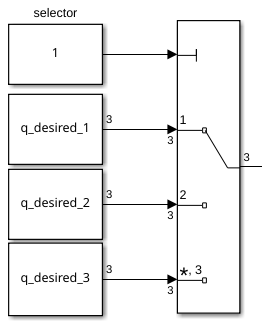
this selection block is linked to:
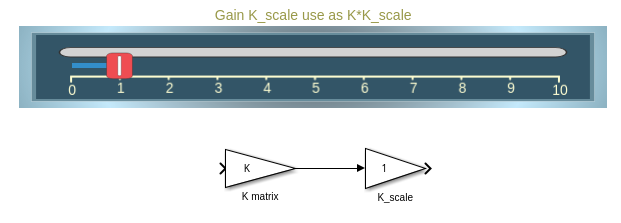
Scale Kd and Kp
By using the sliders you can alter the gain value of their corresponding K_scale blocks:
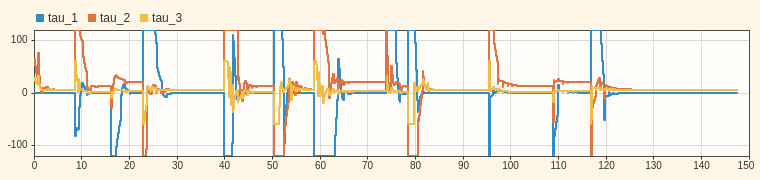
View Torque Trajectory
The Dashboard scope allows you to see the current torques live during simulation (like a scope).
Task 1
Open the file Exercise_5_3_1.slx and complete the control scheme the missing blocks from the Robotic System toolbox.
Use the following blocks:
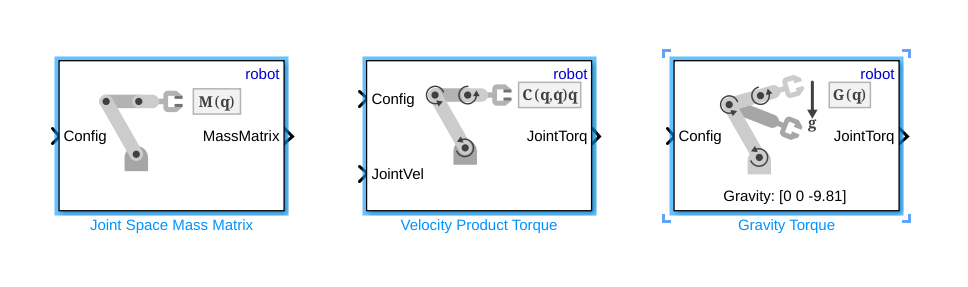
specify:
- 'robot' as Rigid body tree
Task 2
Open the file Exercise_5_3_2.slx and complete the control scheme using the following block:
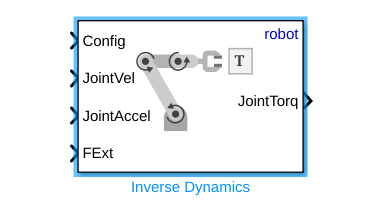
specify:
- 'robot' as Rigid body tree
The inputs are identical to those explained in Tutorial 4 for the function "inverseDynamics()".