Inverse Kinematic Algorithm
Utilizing the Jacobian lets us setup an algorithm to find a numerical inverse kinematic solution. This approach can be used for redundant manipulators or manipulators where no closed-form solution (analytical solution) exists.
The general idea is to compute the direction from the current end-effector to the desired pose. Using this velocity vector, you iteratively approach the desired pose using an euler discretization. At each discrete step, you consider the new end-effector pose and the new velocity vector until convergence.
These algorithms use the analytical Jacobian, as it encodes the desired orientation in terms of e.g. euler angles.
Jacobian (pseudo-)inverse
Objective:
Select \(\dot{q}\) so that \(\dot{e} =\dot{x_d } -\dot{x_{\textrm{ee}} } =\dot{x_d } -J_A \left(q\right)\cdot \dot{q} <0\)
Theory:
If we choose \(\dot{q} =J_A^{-1} \left(q\right)\cdot \left(\dot{x_d } +K\cdot e\right)\), then the error dynamics is linear:
$$ \dot{e} +K\cdot e=0 $$
The convergence to zero depends on the eigenvalues of K. The larger the Eigenvalues, the faster the convergence. However, very large gains can break discrete-time implementations (overshoot) or violate joint limits.
Algorithm:
For each discrete time step k with \(\Delta t\):
$$ q\left(t_{k+1} \right)=q\left(t_k \right)+\dot{q} \left(t_k \right)\cdot \Delta t $$
until convergence.
The Jacobian used for computations is only valid for the joint configuration they were computed with. Choosing a timestep \(\Delta t\) that is too large may result not result in convergence.
Control scheme:
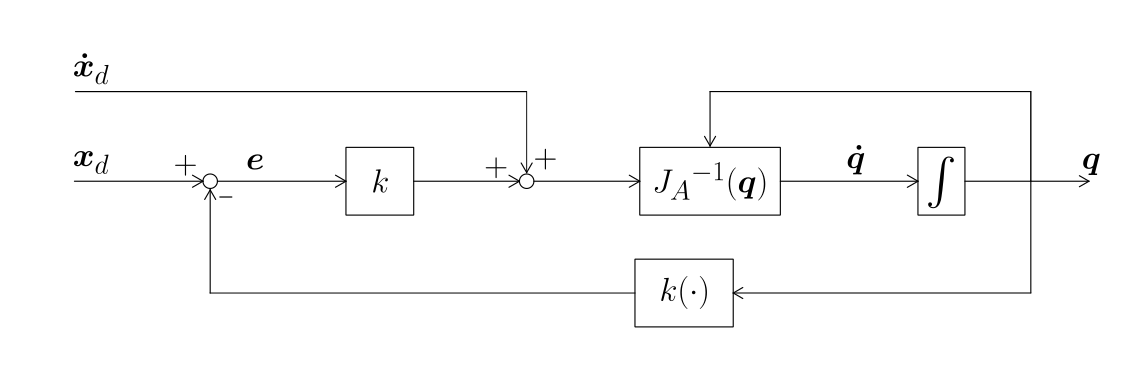
where \(k\left(\cdot \right)\) is the forward kinematic of the q.
Notes:
- Usually \(\dot{x_d } =0\) and the steady-state error is 0 since there is an integrator in the loop
- For redundant manipulators, the pseudo-inverse has to be used as J is a nonsquare matrix.
Jacobian Transposed
Objective:
Select \(\dot{q}\) so that \(\dot{e} =\dot{x_d } -\dot{x_{\textrm{ee}} } =\dot{x_d } -J_A \left(q\right)\cdot \dot{q} <0\)
Theory:
Use Lyapunov's direct method to ensure the asymptotic stability:
$$ V\left(e\right)=\frac{1}{2}\cdot e^T \cdot K\cdot e $$
$$ \dot{V} \left(e\right)=e^T \cdot K\cdot \dot{x_d } -e^T \cdot K\cdot J_A \left(q\right)\cdot \dot{q} $$
Steps:
Choosing \(\dot{q} =J_A^T \left(q\right)\cdot K\cdot e\) then:
$$ \dot{V} \left(e\right)=e^T \cdot K\cdot \dot{x_d } -e^T \cdot K\cdot J_A^T \left(q\right)\cdot \dot{q} $$
if \(\dot{x_d } =0\), then \(\dot{V} <0\) when \(J_A\) is full rank, assuring asymptotic stability.
Scheme:
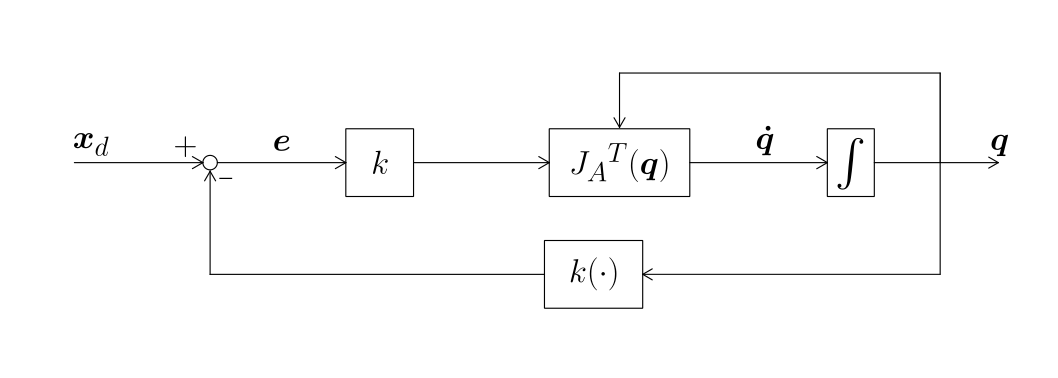
where \(k\left(\cdot \right)\) is the forward kinematic of the manipulator.
Notes:
- Only the computation of \(J_A^T \left(q\right)\) and \(k\left(\cdot \right)\) is required.
- The error in orientation has to be handled with care (the use of Euler angles is not the best option)