Algorisme de cinemàtica inversa
Fer servir el jacobià ens permet configurar un algorisme per trobar una solució numèrica de cinemàtica inversa. Aquest enfocament es pot utilitzar per a manipuladors redundants o manipuladors on no existeix cap solució en forma tancada (solució analítica).
La idea general és calcular la direcció des de l’efector final actual fins a la postura desitjada. Fent servir aquest vector de velocitat, t’aproximes iterativament a la postura desitjada mitjançant una discretització d’Euler. A cada pas discret, consideres la nova postura de l’efector final i el nou vector de velocitat fins a la convergència.
Aquests algorismes fan servir el jacobià analític, ja que codifica l’orientació desitjada en termes de, per exemple, angles d’Euler.
(Pseudo-)inversa del jacobià
Objectiu:
Selecciona \(\dot{q}\) de manera que \(\dot{e} =\dot{x_d } -\dot{x_{\textrm{ee}} } =\dot{x_d } -J_A \left(q\right)\cdot \dot{q} <0\)
Teoria:
Si triem \(\dot{q} =J_A^{-1} \left(q\right)\cdot \left(\dot{x_d } +K\cdot e\right)\), aleshores la dinàmica de l’error és lineal:
$$ \dot{e} +K\cdot e=0 $$
La convergència a zero depèn dels valors propis de K. Com més grans siguin els valors propis, més ràpida serà la convergència. Tanmateix, guanys molt grans poden trencar implementacions en temps discret (sobreeiximent) o violar els límits articulars.
Algorisme:
Per a cada pas de temps discret k amb \(\Delta t\):
$$ q\left(t_{k+1} \right)=q\left(t_k \right)+\dot{q} \left(t_k \right)\cdot \Delta t $$
fins a la convergència.
El jacobià utilitzat per als càlculs només és vàlid per a la configuració articular amb què s’ha calculat. Triar un pas temporal \(\Delta t\) massa gran pot fer que no hi hagi convergència.
Esquema de control:
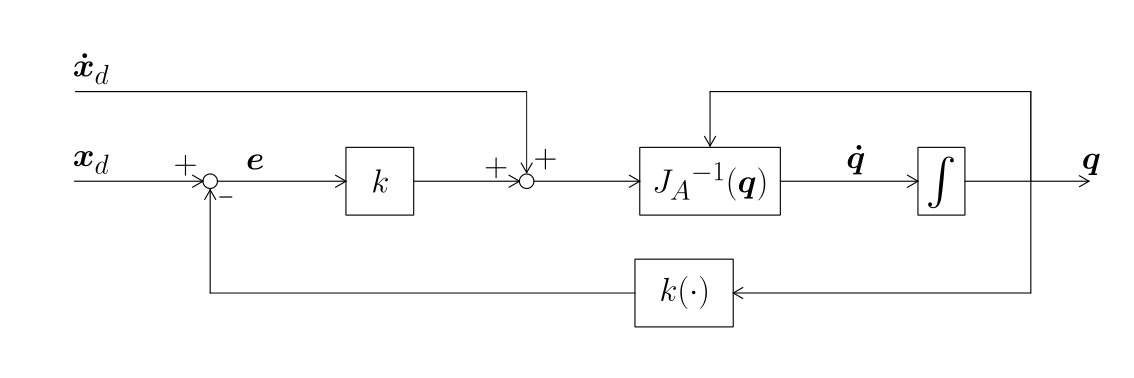
on \(k\left(\cdot \right)\) és la cinemàtica directa de q.
Notes:
- Normalment \(\dot{x_d } =0\) i l’error en règim estacionari és 0, ja que hi ha un integrador al bucle
- Per a manipuladors redundants, s’ha de fer servir la pseudoinversa, ja que J és una matriu no quadrada.
Transposada del jacobià
Objectiu:
Selecciona \(\dot{q}\) de manera que \(\dot{e} =\dot{x_d } -\dot{x_{\textrm{ee}} } =\dot{x_d } -J_A \left(q\right)\cdot \dot{q} <0\)
Teoria:
Fes servir el mètode directe de Lyapunov per garantir l’estabilitat asimptòtica:
$$ V\left(e\right)=\frac{1}{2}\cdot e^T \cdot K\cdot e $$
$$ \dot{V} \left(e\right)=e^T \cdot K\cdot \dot{x_d } -e^T \cdot K\cdot J_A \left(q\right)\cdot \dot{q} $$
Passos:
Triant \(\dot{q} =J_A^T \left(q\right)\cdot K\cdot e\), aleshores:
$$ \dot{V} \left(e\right)=e^T \cdot K\cdot \dot{x_d } -e^T \cdot K\cdot J_A^T \left(q\right)\cdot \dot{q} $$
si \(\dot{x_d } =0\), aleshores \(\dot{V} <0\) quan \(J_A\) és de rang complet, assegurant l’estabilitat asimptòtica.
Esquema:
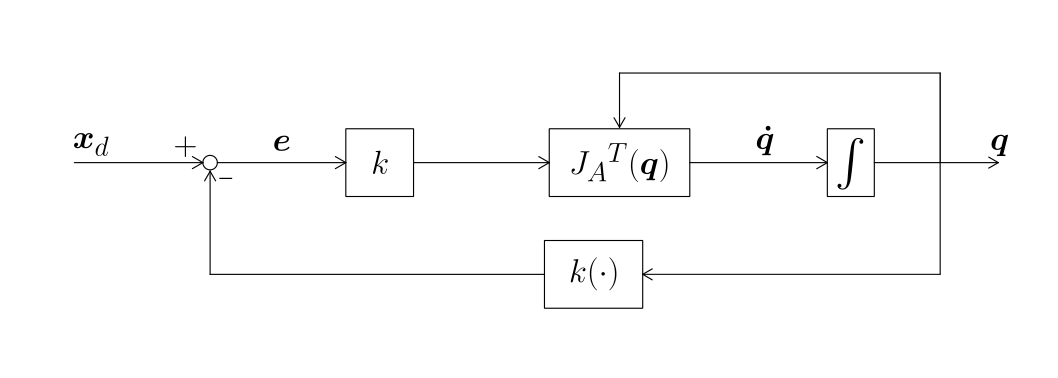
on \(k\left(\cdot \right)\) és la cinemàtica directa del manipulador.
Notes:
- Només cal calcular \(J_A^T \left(q\right)\) i \(k\left(\cdot \right)\).
- L’error d’orientació s’ha de tractar amb cura (l’ús d’angles d’Euler no és la millor opció).